What Makes the BIP39 Word Checklist Special One Of Cue Criteria
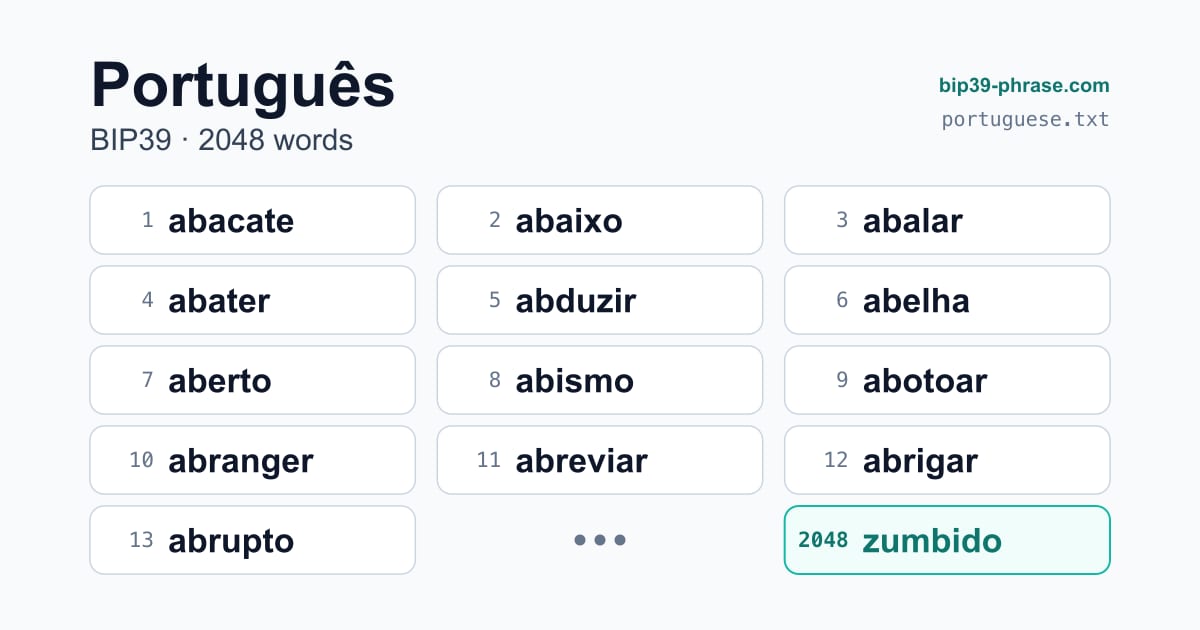
The BIP39 word list looks deceptively simple. At first glance, it is just a dictionary of 2048 words that helps a person write down a wallet backup in plain language instead of raw binary. That simplicity is part of the appeal, but it is also what hides the real design work. BIP39 is not just a list of memorable words. It is a tightly constrained system for turning entropy into a human-readable mnemonic, then turning that mnemonic bip 39 dictionary back into a deterministic seed in a way that is predictable, portable, and strict about every detail that matters.
That combination is what sets BIP39 apart from a casual recovery phrase or an ad hoc mnemonic scheme. The standard, formally titled “Mnemonic code for generating deterministic keys,” was written so wallets could derive keys from a word sequence using a defined process. The words are only the visible layer. Underneath, there is structure, checksum logic, language design, normalization rules, and a deliberate emphasis on minimizing ambiguity.
The word list is not just a vocabulary, it is a lookup system
The most important thing to understand about the BIP39 word list is that its role is mechanical, not literary. These words are chosen so they can reliably encode binary data. A mnemonic sentence is built from entropy of 128 to 256 bits, with crypto a checksum added, and the resulting bitstream is split into 11-bit chunks. Each chunk points to one word in a 2048-word list. That means the list is sized for a very specific job. It is not an arbitrary set of words, and it is not designed for natural language flavor.
This is where a lot of the uniqueness comes from. A normal word list might be optimized for memorability alone. BIP39 has to balance memorability with encoding efficiency and error resistance. With 2048 words, every word can represent exactly 11 bits. That neat match is part of why the standard works so cleanly. A 12-word mnemonic, for example, is not just a shorter sentence. It is a compact encoding of entropy plus checksum in a format that can be transformed back into a seed with no guesswork if the input is correct.
People who search for a bip39 generator, a bip39 mnemonic, or a bip39 converter are usually seeing only the surface of that design. The word list is the engine. The sentence is the dashboard display.
The first four letters matter more than most people realize
One of the most distinctive features of the BIP39 dictionary is the rule that the first four letters of each word uniquely identify it. That sounds like a small implementation detail, but it has real consequences. It means many words can be recognized, checked, or entered with less effort, while still preserving unambiguous mapping to a single list entry.
That design choice reflects a practical balance. Recovery phrases are often copied by hand, read aloud, typed into a wallet, or entered on a device with limited screen space. If a word can be reliably identified after only four letters, the user gets some protection against partial transcription errors and some freedom in how the phrase is handled. The list also avoids similar-looking words, which reduces confusion during manual backup and recovery.
This is one reason BIP39 feels more disciplined than many mnemonic systems. It is not enough for the words to be short or familiar. They must also stay distinct in a way that survives bad handwriting, poor memory, and rushed recovery.
The checksum is part of the phrase, not an afterthought
BIP39 is often described as a seed phrase standard, but technically the mnemonic is a coded representation of entropy plus checksum. That checksum is not decoration. It is a verification layer that catches mistakes before the seed is generated. The checksum is formed from the first ENT/32 bits of the SHA-256 hash of the entropy. Those bits are appended to the original entropy, and the combined data is split into the 11-bit segments that select words from the list.
That design gives the phrase a built-in integrity check. If one word is wrong, the phrase may fail validation or decode to a completely different seed. That can be unsettling, but it is part of the point. A bip39 mnemonic is supposed to be deterministic. It either matches the encoded entropy and checksum or it does not. There is no fuzzy recovery at the protocol level.
In practice, this is why a bip39 mnemonic code converter or a bip39 tool is useful during testing and education. It lets someone see how the words map to structure, and it helps explain why even one bad word can break the sequence. A recovery phrase is not meant to be “close enough.” It is meant to be exact.
The seed is derived one way, and that matters
Another reason BIP39 stands apart from simpler mnemonic approaches is that the conversion is one-way. The mnemonic can be used to generate a seed, but the seed does not preserve any reversible relationship to the original mnemonic beyond what the algorithm defines. Changing the word list changes the resulting seed. Translating the mnemonic into another language does not preserve the same seed either.
That is a critical point, and it is easy to miss if you only think of the words as a human-friendly label. In BIP39, the words are part of the cryptographic input. If you alter the list, the output changes. If you switch languages, the output changes. That is why the standard is so sensitive to wording and so cautious about language support.
People sometimes ask what is bip39 because they think it is just a universal phrase format. It is not universal in the loose sense. It is a specific specification with fixed assumptions. The word list is not interchangeable, and the phrase is not a semantic sentence that can be paraphrased. It is encoded data.
Why the English list became the practical default
The official English BIP39 word list contains 2048 words, and the authors strongly discourage using non-English wordlists for generating mnemonics. The reason is not that other languages are impossible. The reason is interoperability. Most wallets support only the English list, so using a different language can create practical recovery problems. A phrase that looks valid in one implementation may not be portable to another if the receiving wallet expects English words.
That portability issue is one of the biggest differences between BIP39 and a purely local mnemonic scheme. The standard is not only trying to encode entropy. It is trying to do so in a way that survives movement between tools, backups, and time. If a bip39 seed phrase is going to be written on paper and stored for years, compatibility matters as much as elegance.
This is why downloading a bip39 word list pdf or browsing a bip39 list can be helpful for study, but it is not the same thing as creating a wallet backup. The list itself is only one layer of the system. The ecosystem around it matters. A bip39 store or a bip39 online tool may help with inspection, but the real question is whether the output will still be accepted when recovery is needed.
The passphrase changes the security model
BIP39 also supports an optional passphrase, and that feature gives the standard a level of flexibility that many people underestimate. If no passphrase is provided, an empty string is used. If a passphrase is provided, it is included in seed derivation using PBKDF2 with HMAC-SHA512, 2048 iterations, and a 512-bit output. The mnemonic and the passphrase are both normalized with UTF-8 NFKD before derivation.
The practical effect is significant. The same mnemonic can lead to different seeds depending on the passphrase. That makes the passphrase more than a convenience. It becomes part of the protection scheme. The specification also notes an important property here, plausible deniability. Every passphrase yields a valid seed, but only the correct one reveals the intended wallet.
That is one of the more unusual characteristics of BIP39 compared with many mnemonic standards. It does not just recover one hidden state. It can map one phrase to multiple valid seeds, depending on the passphrase. That can be useful, but it also introduces responsibility. A passphrase that is forgotten, mistyped, or stored poorly can make recovery impossible. A bip39 passphrase is powerful precisely because the standard treats it as a real input, not a label.
BIP39 is strict about text handling
Normalization sounds like a technical footnote, but in a recovery standard, it is essential. BIP39 specifies UTF-8 NFKD normalization for both the mnemonic and the passphrase. That means the exact text handling rules are part of the standard, not a convenience left to wallet developers. In a system where a single character difference can change the derived seed, consistency across implementations is crucial.
This is another area where the bip39 word list is unusual among mnemonic systems. The words are not just meant to be readable. They are meant to survive software differences, keyboard differences, and language processing quirks. If two tools disagree on how to interpret the same text, recovery breaks. BIP39 tries to minimize that risk by defining normalization clearly.
That level of specificity is one reason the standard has endured. It is not glamorous, but it prevents subtle failures. Anyone who has dealt with encoding problems, especially across platforms, understands how important that is.
The list was designed for recovery, not poetry
There is a certain elegance to the BIP39 word list, but it is a functional elegance. The words are chosen to reduce confusion and preserve determinism. Similar-looking words are avoided. The first four letters identify each word uniquely. The list is sorted for efficient lookup. Those features make the standard better at recovery, verification, and manual handling.
This is where BIP39 differs from some mnemonic traditions that prioritize memorability, rhythm, or storytelling. BIP39 does not need the words to form a sentence with meaning. It needs them to carry encoded entropy without distortion. That is why the list can feel oddly plain compared with more literary mnemonic systems. Plainness is not a weakness here. It is a safety feature.
Anyone who has used a bip39 generator or browsed bip39 words in a wallet interface can see this tension immediately. The phrase is easy enough to write down, but it does not beg to be remembered through semantics alone. The standard expects the user to treat it as a precise backup, not as a phrase to casually recall from memory.
Why BIP39 became the reference point, and why it is still discussed critically
BIP39 became a reference point because it is simple to explain, easy for wallets to adopt, and effective in practice. It gives developers a clear way to convert entropy into a portable mnemonic and then into a seed suitable for deterministic wallets. For many users, that solved a real problem: how to back up a wallet without copying raw hex strings or unpredictable internal data.
At the same time, the standard has known limitations, which is why the BIP39 authors identify SLIP-0039 as a proposed successor intended to address shortcomings of BIP39. That alone tells you something important. Even widely used standards can be practical without being perfect. BIP39’s success came from its balance of usability and structure, but its design choices also create trade-offs. A mnemonic that is easy to move across wallets may still be fragile if a passphrase is forgotten or if a different language list is used inconsistently.
That is why searches for bip39 reviews, bip39 github, bip39 iancoleman, or bip39 recoverer often cluster around the same theme: people want to understand how trustworthy the system is before they rely on it. The answer is not that BIP39 is magical. The answer is that it is precise. It rewards exact handling and punishes improvisation.
What makes it unique, in plain terms
BIP39 stands out among mnemonic standards because it treats the word list as part of a cryptographic encoding system, not merely a memory aid. The 2048-word English list is carefully constrained so every word can be identified by its first four letters, the full set avoids confusing similarities, and the resulting phrase carries checksum-protected entropy that can be converted into a deterministic seed. The optional passphrase adds another layer, including plausible deniability, but also more responsibility for the user.
That is the real character of the standard. It is human-readable, but not casual. It is simple to look at, but exacting under the hood. If you want a bip39 mnemonic code that can move between devices and remain stable over time, the uniqueness of the word list is not an accident. It is the foundation of the whole design.
For anyone exploring a bip39 converter, a bip39 mnemonic, or a bip39 word list pdf, the lesson is the same. The words matter, but they matter because of the system they belong to. BIP39 is unique not because it uses words, but because it turns words into a disciplined representation of entropy, checksum, and seed derivation with very little room for ambiguity.